Deutsch
Key facts at a glance: When is the best time to visit Madagascar for photography?
Madagascar is a delight all year round – but there’s no single ideal time of year on the Red Island when you can experience everything at once. The perfect time to visit depends entirely on which regions you want to explore and which animals or landscapes you’d like to see and photograph. We’d be happy to advise you personally!
- Lemurs: October and November
- Amphibians, reptiles: December until the end of April
- Chameleons: March and April
- Birds: Early October to mid-December
- Whales/Cetaceans: August
- Whale sharks: October
- Landscape: November
The best time to visit Madagascar
When is the best time to visit Madagascar for photography? There’s no simple answer to this question, as every species of plant and animal has its own season. We’ve therefore put together a brief overview here to help you decide the best time to visit, depending on what you’d like to see and experience in Madagascar.
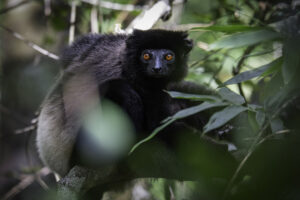
Edwards’s sifaka in the rainforest of Ranomafana, Madagascar
The best time of year to visit lemurs
Lemurs can generally be observed in Madagascar all year round. With a few exceptions amongst the nocturnal lemurs, these animals are active throughout the year. However, the best time to observe them is in the months of October and November. During this period, an exciting phase in the development of the young begins for many species: The baby lemurs now often move from their mother’s belly to her back and are becoming increasingly independent. Their first tentative forays into their surroundings then become part of the young animals’ daily routine, providing particularly wonderful and lively opportunities for observation.

Madagascar harrier-hawk (Polyboroides radiatus) in the spiny forest of Ifaty in southern Madagascar
The best time of year for birdwatching
For birdwatching and bird photography, the months from early October to mid-December are particularly ideal. During this period, most bird species in Madagascar are in their courtship and breeding season. This means they are particularly active, sing a great deal and display their striking breeding plumage. As a result, the birds are not only easier to spot, but also make for particularly impressive photographs. The high level of activity and the diversity of species make these months one of the best times for birdwatching on the island.
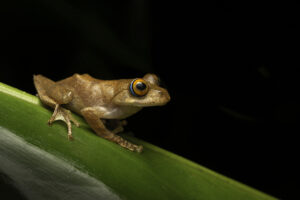
Boophis quasiboehmei, a frog in Madagascar’s eastern rainforests
The best time of year for reptiles and amphibians
The rainy season is considered the ideal time to visit for observing amphibians and reptiles. This period runs roughly from December to the end of April. Due to the increased humidity and lush vegetation, many species are particularly active at this time. During this time, whilst herping – that is, actively searching for reptiles and amphibians – you can spot numerous frogs, chameleons, geckos and other reptiles and amphibians that are often harder to find, or impossible to find at all, during the dry season.
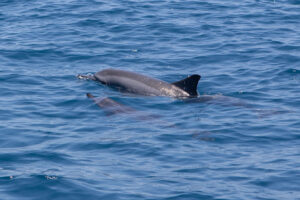
Eastern Pacific or spinner dolphin (Stenella longirostris) with a calf in the sea off Nosy Iranja, Madagascar
The best time of year to see whales and dolphins
Spotting marine mammals such as humpback whales, fin whales and various species of dolphin is also a special experience in Madagascar. The best time for whale watching begins around August, when the animals migrate to the waters around Madagascar to spend time there or breed. With a bit of luck, you can witness the whales’ spectacular breaches and social behaviour.
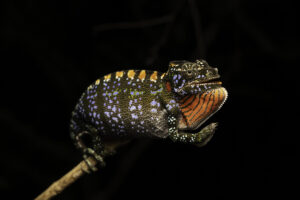
Laborde’s Chameleon (Furcifer labordi) in the Kirindy dry forest in Madagascar, displaying her gravidity colouration
The best time of year to visit Chameleons
Chameleons are among Madagascar’s most fascinating animal species. The country is regarded as a global hotspot for chameleon diversity: nowhere else are there as many species as here – around 40 per cent of all known chameleon species are found exclusively or predominantly in Madagascar. For travellers wishing to see chameleons at their most beautiful and active, the months of March and April are considered the ideal time to visit. Whilst hatchlings are already gaining their first experiences of their surroundings, many adult chameleons are still in their breeding season. During this phase, they display their most striking and colourful patterns.
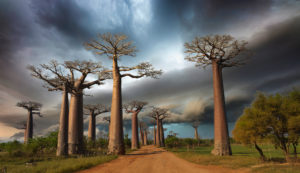
The famous Baobab Avenue with its iconic Adansonia grandidieri in western Madagascar
The best time of year for landscape photography
Anyone keen to photograph particularly striking landscapes should visit Madagascar in November, at the start of the rainy season. During this transitional period between the dry and rainy seasons, impressive cloud formations, dramatic skies and a striking interplay of light and shadow often occur. The combination of revitalised vegetation, lush greenery and dynamic weather conditions provides exceptionally atmospheric photo opportunities. Many travellers therefore consider this time of year to be one of the best periods for landscape photography in Madagascar.
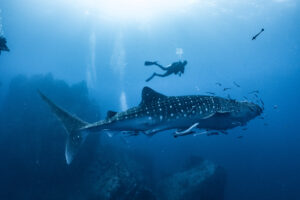
Off the coast of Madagascar, you can go snorkelling mainly with young male whale sharks
The best time of year to see whale sharks
Another highlight is swimming with whale sharks, which is possible around many of Madagascar’s islands. The best time for this is in October, when these gentle giants are out and about in the plankton-rich waters. During this period, conditions are ideal for getting up close to these impressive creatures whilst snorkelling.
Our favourite time of year to travel
Our preferred time to visit Madagascar is between mid-October and the end of April, although February is generally avoided due to the increased risk of cyclones. Overall, this period offers excellent conditions for a wide range of travel interests, as nature, wildlife and landscapes are at their most varied and vibrant during this time.
At the same time, if you are travelling during this period, you should bear in mind that not all regions and national parks are fully accessible. Due to the onset of the rainy season, road conditions may become more difficult, particularly in remote destinations. A well-known example of this is the Tsingy de Bemaraha National Park, which is inaccessible during the rainy season.
For this reason, careful travel planning is particularly important if you wish to travel to Madagascar. Depending on your individual interests – be it wildlife watching, photography or exploring specific landscapes – the best routes and timeframes can vary considerably. As conditions in Madagascar vary greatly depending on the season, a personal consultation is definitely the best option. This allows the trip to be tailored perfectly to your wishes and the local conditions.